
Home / Examples / Piezoelectric Analysis [Rayleigh] / Example 22: Thermoelastic Damping
The piezo-resonant analysis with thermoelastic damping taken into account is performed for Q factor.
As a result, temperature distribution and Q factor are solved.
Approximated frequency is given by resonant analysis with deselecting thermoelastic damping.
The approximated frequency is explained at the end of this page.
Unless specified in the list below, the default conditions will be applied.
Results will vary depending on Femtet version and the PC environment.
Item |
Settings |
Solver |
Piezoelectric Analysis [Rayleigh] |
Analysis Space |
2D |
Analysis Type |
Resonant Analysis |
Unit |
mm |
Options |
Take into account thermoelastic damping |
Resonant Analysis Tab
Tab |
Setting Item |
Settings |
Resonant Analysis |
Number of Modes |
3 |
Approximated Frequency |
1.730×10³ [Hz] |
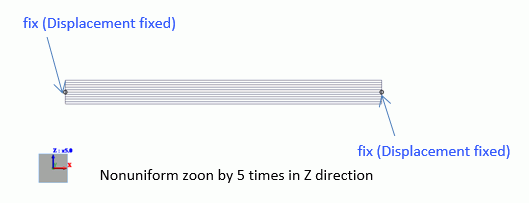
Ten rectangles are stacked in the Z direction. In this way, temperature change in the Z direction can be represented precisely with less meshes.
The model is 20 mm in the longitudinal direction and 0.3 mm in thickness. The thickness is displayed five times the actual dimension.
Body Number/Type |
Body Attribute Name |
Material Name |
n/Solid (0<=n<10) |
BEAM |
Material_Property_001 |
Body Attribute Name |
Tab |
Analysis Domain |
BEAM |
Direction |
Specified by: Vector Vector: X=Y=0.0, Z=1.0 |
|
Thickness/Width |
Thickness of Sheet Body: 1 mm |
Material Name |
Tab |
Settings |
Material_Property_001 |
Density |
7.8×10³ [kg/m3] |
Piezoelectricity |
Material Type: Non-Piezoelectric Anisotropy: Isotropic Young's Modulus: 2×10¹¹ [N/m2] |
|
Specific Heat |
2×10³ [J/kg/deg] |
|
Thermal Conductivity |
42 [W/m/deg] |
|
Coefficient of Linear Thermal Expansion |
1.2×10⁵ [1/deg] |
Boundary Condition Name/Topology |
Tab |
Boundary Condition Type |
Settings |
FIX/Face |
Mechanical |
Displacement |
UX=0, UY=0, UZ=0 |
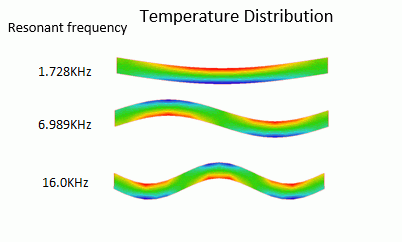
Temperature distributions are displayed as below. A vertical direction is extended 5 times by using nonuniform zoom function.
Change thickness between 0.5 mm and 0.03 mm to get a complex resonant frequency. Q factor will be given by the following equation with the complex resonant frequency.
Q factor=real part of the complex resonant frequency/imaginary part of the complex resonant frequency/2
Approximated frequency is given by resonant analysis with deselecting thermoelastic damping. The approximated frequency in the thermoelastic damping analysis will be explained later on.
If the thickness is changed, the resonant frequency and Q factor will be changed accordingly. Figure 1 below shows their relationship. The calculated Q factors and theoretical values are well matching.
Thickness of 0.3 is applied in this session's project file. A variable dz defined in the project is one tenth of the thickness. By changing dz, you can trace the results below.
List 1. Thickness and Q factor
Thickness [m] |
Reference Frequency [Hz] |
Resonant Frequency Real part [Hz] |
Resonant Frequency Imaginary part [Hz] |
Q factor |
0.5 |
2.877e3 |
2.878e3 |
5.578e-3 |
2.579e+5 |
0.3 |
1.728e3 |
1.728e3 |
1.462e-2 |
5.913e+4 |
0.1 |
5.764e2 |
5.765e2 |
7.488e-2 |
3.849e+3 |
0.07 |
4.035e2 |
4.035e2 |
4.204e-2 |
4.799e+3 |
0.05 |
2.882e2 |
2.882e2 |
1.296e-2 |
1.112e+4 |
0.03 |
1.728e2 |
1.728e2 |
1.726e-3 |
5.008e+4 |
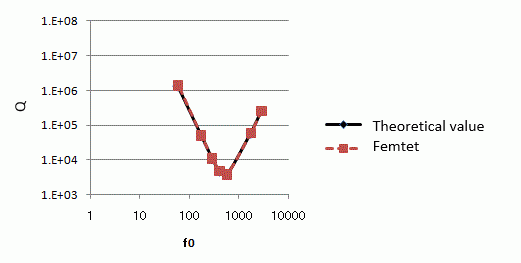
Fig 1. Real Part of Resonant Frequency and Q Factor: Comparison Between Femtet Calculation and Theoretical Values
Equations of theoretical value
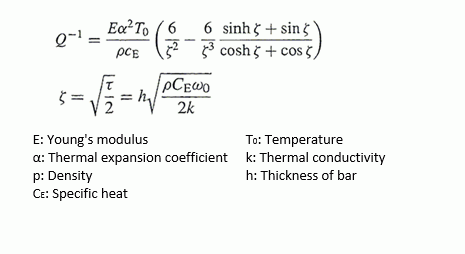
Reference: H.Itoh, JJAP,50 (2011) 087203
Approximated Frequency
The meaning of using approximated frequency in the analysis with thermoelastic damping taken into consideration In the resonant analysis with thermoelastic damping taken into account, the expression (1) below must be solved, where s represents frequency, x represents vector for distributions of displacement and temperature, A, B, and C represent matrices reflecting model shape and material property. Since solving the expression (1) is not easy, an simplified expression (2) is used for analysis, where approximated frequency is used as sref. The approximated frequency, therefore, must be close to the resonant frequency that is to be obtained.
(A+sB+s2C)x=0 (1)
(A+srefB+s2C)x=0 (2)